A Lucky Upgrade in Panama City
Panama City, Panama
My journey to Peru began with a connection in Panama City—and a minimum-bid upgrade that unexpectedly cleared.
Journeys
From an unexpected upgrade in Panama City to Lima, Cusco, Machu Picchu, and the trails around Aguas Calientes.
July 24–31, 2026 · Panama City · Lima · Cusco · +2 · 6 entries
Panama City, Panama
My journey to Peru began with a connection in Panama City—and a minimum-bid upgrade that unexpectedly cleared.
Lima, Peru
My first afternoon in Lima moved from tropical fruit and ceviche to chifa cooking and one of Barranco's old neighborhood bars.
Lima, Peru
Exploring central Lima through the Plaza de Armas, the cathedral, Museo Larco, city streets, and a succession of Peruvian dishes.
Cusco, Peru
Days around Cusco revealed layers of ruins, ingenious agricultural terraces, working salt pans, and a multilingual corner of the Andes.
Machu Picchu, Peru
After flights, mountain roads, a train, and one final bus climb, I reached the centerpiece of the journey: Machu Picchu.
Aguas Calientes, Peru
Driven out of a difficult hotel, I spent the final day hiking to two waterfalls, a butterfly sanctuary, and the foot of Machu Picchu.
My journey to Peru began with a connection in Panama City—and a minimum-bid upgrade that unexpectedly cleared.
I never actually entered Panama; I only changed planes in Panama City. Still, this was where my journey to Peru began.
The stopover is worth mentioning because something unexpectedly fortunate happened. I was flying Copa Airlines, one of several Latin American carriers that let passengers bid for an upgrade. You choose an amount within a suggested range and submit it without knowing what anyone else has offered. The upper end of Copa’s range puzzled me—it was higher than the price shown by the “upgrade now” button.
With little expectation of success, I entered the minimum bid. The original ticket had cost a little over $600, and I offered another $400 for the upgrade. Somehow, it cleared. On an earlier trip to Argentina, I had bid well above the minimum and still lost. This time, perhaps no one else on the flight was especially eager to spend the money.
My first afternoon in Lima moved from tropical fruit and ceviche to chifa cooking and one of Barranco's old neighborhood bars.
I arrived in Lima that afternoon and went almost directly to a food-tasting tour. The idea was simple: sample a wide range of Peruvian specialties, including raw tropical fruits and an assortment of unfamiliar snacks.
That was also my introduction to ceviche, one of Peru’s defining dishes. At the time, I knew little about it beyond the bowl in front of me: pale raw fish, sliced onion, a few green leaves, and a sharp citrus marinade. I later learned just how celebrated ceviche is. My own reaction was less enthusiastic. The acidity and raw onion were simply more intense than I enjoyed, and I did not think to take a photograph.
Next we visited a Chinese-Peruvian restaurant. In Peru, restaurants of this tradition are generally known as chifas. The cuisine grew from Chinese migration more than a century ago, and the name is commonly linked to the Chinese phrase chi fan—“to eat a meal”—adapted into local pronunciation.
The chef was not Chinese, but he handled the wok with confidence and prepared beef in a thick sauce. It reminded me of Panda Express. Compared with the Chinese cooking I knew, the beef seemed to have spent a little too long over the heat.
While moving through the city that afternoon, we also stopped at a well-known area for street art. This was the piece that stood out to me.
That evening I went to Juanito, one of Barranco’s most characteristic old bars. Juan Casusol founded it in 1937, and over time it became a gathering place for writers, artists, and the neighborhood’s bohemian community. Its exterior remains remarkably discreet, with barely a sign, and the Casusol family still runs it. The founder was known as Juanito—“little Juan,” using the affectionate Spanish diminutive.
Exploring central Lima through the Plaza de Armas, the cathedral, Museo Larco, city streets, and a succession of Peruvian dishes.
Over the next several days, I joined a series of small group tours and saw a broad cross-section of Lima and its surroundings.
I began at the main square in the historic center, the Plaza de Armas, also known as the Plaza Mayor.
My visit coincided with Peru’s Independence Day celebrations and the approach of a presidential inauguration following the country’s five-year election cycle. The center of the square had been closed off, so I could only walk around its perimeter.
From there I visited the Cathedral of Lima. Construction began in 1535, when Francisco Pizarro, the Spanish conquistador who founded the colonial city, laid its first stone. His presence runs throughout the building. One story goes back to his second expedition, when his men were stranded on Gallo Island and many wanted to return to Panama. Pizarro drew a line in the sand; only thirteen men—the “Famous Thirteen”—crossed it and chose to continue south. According to the familiar retelling, his pitch was stark: follow him toward the possibility of wealth, or return north to the poverty they already knew.
I also passed through several smaller museums and collections. So many compact artifacts have been excavated in the region that some collections fill tier after tier of shelving. My favorite was this wonderfully abstract expression.
Museo Larco offered something entirely different. Its separate Checan Erotic Gallery presents erotic ceramics from ancient Peru, especially works associated with the Moche culture. The museum itself describes the gallery as a major collection devoted to sexuality and eroticism in ancient Peruvian art.
Uber made it easy to move between widely scattered parts of Lima without planning much around transportation. The driving, however, was an experience in itself. Most taxis had manual transmissions, and their drivers threaded through gaps and overtook with a precision that repeatedly looked like an imminent collision. Somehow, it all worked.
Peru’s tourism infrastructure also struck me as far more developed than the country’s broader level of development might suggest. Almost every established business I visited—even a modest stall with a permanent storefront—could produce a card terminal. Sometimes it had been unused long enough to need charging and a restart, but it was there. I barely needed cash outside informal street stalls. Tourist-site restrooms were similarly reliable: flushing toilets, paper, soap, and running water, not merely empty dispensers mounted on a wall. I had not found that level of consistency even on previous trips to Australia and New Zealand.
Food became another recurring part of these days. I am still not sure I could define “Peruvian cuisine” neatly, so I outsourced some of the decision-making. At restaurants, I photographed the entire menu and asked ChatGPT what to order. It was shamelessly convenient; by then, I could not even be bothered to study an English menu.
The dish most unlike anything I would encounter at home was roasted guinea pig. In much of the world it is a pet; in Peru it is dinner.
I also ordered a sampler of Peruvian specialties, with ceviche in the lower-right corner. The accompanying drink was equally unexpected: iced Americano mixed with passion-fruit juice. It sounded implausible, but there it was.
That brought my time in Lima to a close. Next came Cusco.
Days around Cusco revealed layers of ruins, ingenious agricultural terraces, working salt pans, and a multilingual corner of the Andes.
The most striking thing about the area around Cusco is the sheer number of archaeological sites. There were so many that, after a while, I could no longer reliably match every ruin to its name.
The Inca used terraces to stabilize steep slopes while expanding the amount of cultivable land. Around Cusco, terraces seem to cover every available mountainside. The region’s large temperature swings mean that elevation can change not only the temperature but, at times, the growing conditions themselves, allowing different crops to thrive at different levels. The circular terraces below were described to me as an experimental site used to learn what should be planted at each elevation.
Nearby, mineral-rich spring water feeds a vast complex of salt pans. The water is diverted through many levels of shallow terraces and left to evaporate in the sun. The site has a long history, but it is not simply a preserved relic: people were still actively harvesting salt when I visited.
The road between these sites offered its own memorable landscapes.
I joined several different full-day and half-day tours during this stretch of the journey. Beyond the sites themselves, the conversations gave me a broader sense of the country—and perhaps a clearer idea of why I travel in the first place.
One recurring subject was Peru’s long history of movement between continents. Spanish colonial rule is the obvious background, but several of my guides had much more recent European ties: a parent or grandparent from Europe, or a childhood spent there. International families seemed ordinary rather than exceptional. That felt different from much of East Asia, including China, Japan, and South Korea, where cross-cultural marriage is still more likely to be treated as something remarkable.
I was equally impressed by how many languages people moved between. My sample was admittedly biased—guides are more likely than most people to be multilingual—but it extended beyond the tourism professionals. A shopkeeper in Cusco often spoke useful English in addition to Spanish, while many people in the region grew up speaking Quechua. Three languages could feel like a practical baseline. In China, fluent English alone is often considered an accomplishment; adding a third language draws real admiration.
The European travelers on my tours reinforced the point. One day, two Italians arrived speaking neither Spanish nor English, apparently trusting that Italian and Spanish were close enough to get them through Peru. When the guide struggled to communicate with them, another traveler simply stepped forward: he spoke both languages and could interpret. The problem disappeared almost immediately.
Not every guide, of course, was comfortable in English. A few had memorized the specialized vocabulary needed for their work but had difficulty building a complete sentence beyond it. They spoke in fragments, sometimes mixing in Spanish words. Because I know a little Spanish, I could recognize what was happening, but following the explanation was still difficult. A native English speaker might have filled in the gaps; I could not always do so. It was a humbling reminder that my own English still has room to improve.
With that, my time around Cusco came to an end. Machu Picchu was next.
After flights, mountain roads, a train, and one final bus climb, I reached the centerpiece of the journey: Machu Picchu.
This was the day I finally reached the centerpiece of the journey: Machu Picchu.
It is among the most difficult famous places I have ever visited—Antarctica may be the only destination that demanded more. Of the New Seven Wonders of the World, it must be one of the least straightforward to reach. First comes the long journey to South America, then a flight to Cusco. At more than 3,400 m above sea level, Cusco demands time to acclimatize. From there, I spent about two hours on the road to Urubamba in the Sacred Valley, boarded a train to Aguas Calientes, and rode for another hour and a half. The final choice was either a roughly two-and-a-half-hour climb or a twenty-minute bus ride up a genuinely unnerving series of switchbacks. Only then did the entrance appear. Few major attractions require this many stages.
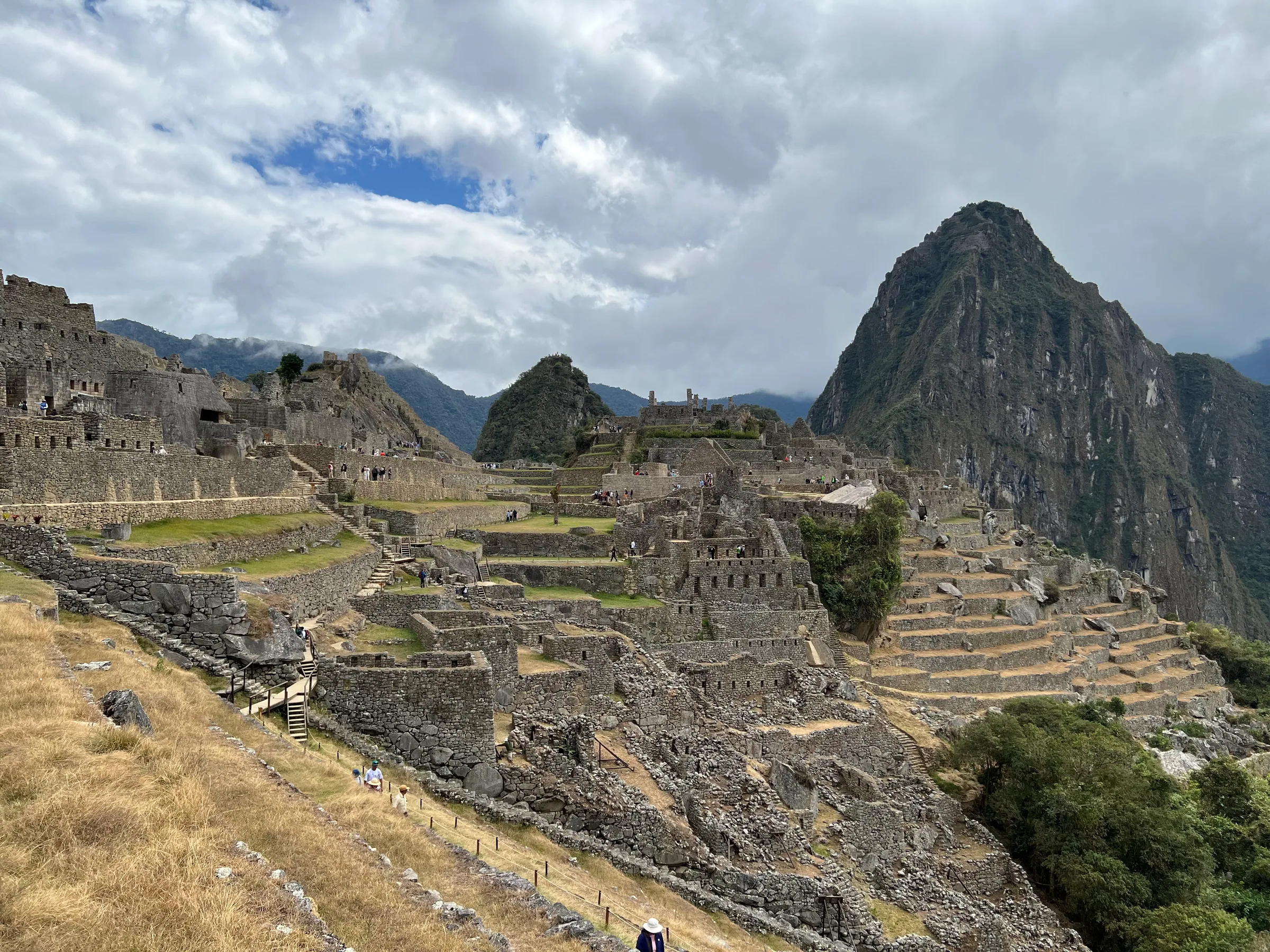
Once I arrived, however, every stage felt worthwhile. My guide shared a great deal of history, but photographs convey the first impression better than another summary of facts.
Here is the wider view.
As the light moved, the color and texture of the entire city seemed to change with it.
My ticket was for Circuit 3, which descends into the urban sector but does not include the highest panoramic overlooks. Circuit 2 is generally considered the best balance: elevated exterior views as well as a closer look inside the site. It is also the first to sell out. If Circuit 2 matters to you, booking six months ahead is sensible; three months was not enough for me. Machu Picchu has firmly joined the small club of places that require half a year of advance planning.
There is also an in-person option. The ticket office in Aguas Calientes releases 1,000 tickets each day for the following days, but in high season even the next day’s allocation may already be gone. That morning my guide opened an app: tomorrow was sold out, while the day after still had about half its spaces. He explained that many buyers were Peruvians and visitors from neighboring countries traveling during school holidays. A family might decide on Machu Picchu, arrive to buy whatever date remained, spend the intervening days around Cusco, and return when their entry time came.
The city is inseparable from the mountain beneath it. In places, uncut bedrock supports the structures; elsewhere, the natural rock itself becomes part of a wall or platform.
A few more views show how completely the two are joined.
Sun protection is essential, and insect repellent is nearly as important. My guide wore gloves through the heat, which seemed odd until mosquitoes left several bites across my hands. Then the gloves made perfect sense.
There is one hotel at the top, in an extraordinary position beside the site. A room was roughly US$2,200 per night. From its location, it seemed entirely possible that opening the curtains would reveal Machu Picchu itself—a reminder of just how wide the range of travel can be when cost is no object.
My guide also told me that a large monolith once stood in Machu Picchu’s main plaza. According to his story, it was removed to make room for a helicopter carrying the king of Spain, then reinstalled after the visit. It was removed again for another visiting Latin American leader, damaged in the process, and could not be put back. The story ended on a distinctly awkward note.
Driven out of a difficult hotel, I spent the final day hiking to two waterfalls, a butterfly sanctuary, and the foot of Machu Picchu.
On the final day of the journey, I explored the area around Aguas Calientes—less by choice than by necessity.
The reason was my three-star hotel, Flower’s House MachuPicchu, which suffered from several serious problems.
First, there was effectively no internet. Each floor had its own Wi-Fi network, except the fifth floor, where I was staying. The fourth- and sixth-floor signals were strong and used the same password, so connecting was easy. Getting online was another matter: Google’s home page took nearly thirty seconds to load, and most other sites were hopeless. I went downstairs and told the front desk that the fifth floor had no Wi-Fi. The receptionist quietly turned off mobile data on her phone before checking the network—strong evidence that she already knew exactly how unusable the hotel’s connection was.
Second, there was no cold water. I have stayed in plenty of hotels where the hot water failed; a broken heater is familiar enough. Cold water failing was new. During the day I had only washed my hands, using whatever cool water remained in the pipes, so I did not notice. That evening, after the tap ran for thirty seconds, the water became painfully hot. The receptionist appeared to know about this problem too. Some repair work required the cold-water line to be shut off regularly, she said, and it would return in ten minutes. It did, briefly. By the middle of the night, the cold water was gone again. Washing my hands became a race against the rising temperature.
Finally, there was the noise. The aging windows would not close properly, and sound insulation was essentially nonexistent. The hotel stood near the railway station, so the whistle of the first train at five in the morning marked the end of sleep. Earplugs softened it somewhat. They were not optional.
Taken together, the lack of internet and reliable water made spending the day in the room impossible. Under better circumstances, I might simply have rested. Instead, I set out for places my guide had recommended the day before. ChatGPT had suggested other sights, but the guide pointed out that one involved a three-hour walk each way. I agreed that was more than I wanted.
I first headed northeast toward a waterfall, passing the open-air Machu Picchu Hot Springs. From the trail above, I could see the entire complex. Water—whether genuinely thermal or not, I could not tell—had been directed into pools of roughly 10 square meters. The surface was clear; the bottom was not visible. Towels were not provided. Unless soaking in hot springs is a personal passion, I would not consider this an essential stop.
About ten minutes farther uphill was the first waterfall, Cataratas de Aguas Calientes. This was a developed attraction, with an entrance shared with the hot springs and admission payable by cash or card. Wooden benches appeared regularly along the trail, making the climb pleasantly manageable.
After descending, I set out for a second destination, the Allcamayo Waterfalls. This trail was almost entirely undeveloped. The first fifteen minutes climbed steeply over uneven stone to a small refreshment stand. There was nowhere to sit along the way; resting meant stopping in place and leaning on my legs. By the time I reached the stand, I was exhausted. I bought a ticket—cash and cards were both accepted—and continued for another five minutes to the first supposed waterfall. My immediate thought was: This counts as a waterfall?
Less than ten minutes farther in, I reached the second waterfall. This one looked considerably more deserving of the name.
The route runs through dense, largely unmanaged forest, and the footing is difficult. An injury—especially a twisted ankle—would become a serious problem very quickly. Insect repellent is also strongly advisable. Halfway in, an enormous unidentified bee or wasp began following me. It stayed with me all the way to the waterfall and most of the way back, disappearing only as I approached the edge of the forest. I would have preferred not to acquire a winged escort.
Unless hiking itself is the goal, I would probably skip this second waterfall. Compared with the first, the physical effort was much greater than the reward. By the time I emerged, my clothes were nearly soaked through with sweat.
From there I walked to the Mariposario of Machu Picchu, a butterfly sanctuary below the mountain. Walking was not a special decision: under ordinary circumstances, Aguas Calientes has almost no road traffic. Vehicles are largely reserved for deliveries and specific commercial uses, including the buses that carry visitors up to Machu Picchu.
The sanctuary held a large number of butterflies. The displays promised many varieties, although one species seemed to dominate during my visit.
At the very end, I took one hazy photograph looking up toward Machu Picchu from below.
With that, the journey was complete.