The Road to Antarctica Begins in Buenos Aires
Buenos Aires, Argentina
After a long and anxious visa process, we finally spent three days discovering Buenos Aires before continuing south to Antarctica.
Journeys
Beginning in Buenos Aires, then continuing toward the end of the world and Antarctica.
January 12–15, 2025 · Buenos Aires · Ushuaia · 2 entries
Buenos Aires, Argentina
After a long and anxious visa process, we finally spent three days discovering Buenos Aires before continuing south to Antarctica.
Ushuaia, Argentina
After choosing a ship, planning the route, and weighing the prospect of the Drake Passage, we finally boarded our expedition vessel in Ushuaia.
After a long and anxious visa process, we finally spent three days discovering Buenos Aires before continuing south to Antarctica.
Our journey to Antarctica began in the capital of Argentina.
By long-established international custom, every international trip begins with a visa. This time, the Argentine visa process handed me a particularly large complication.
Under the rules in effect when we applied, Chinese passport holders with a qualifying US or Schengen visa—and visas from several other countries—could use a simplified entry arrangement. A US green card, however, did not qualify. I found this baffling. A traveler with a US visa was apparently not considered likely to remain in Argentina, while a US permanent resident might be? From my perspective, the distinction made no sense.
Rules were rules, so I needed an Argentine visa. The application itself was not especially complicated. It required the familiar collection of travel plans, hotel and flight bookings, bank statements, and similar documents. The difficulty was timing. In our case at the time, applying through the Argentine consular system in the United States meant that we could not submit until roughly ninety days before the trip. Our flight would arrive on January 12, 2025, so the first practical filing date was a business day after about October 14, 2024.
That alone would have been manageable. What we found online at the time suggested that applicants in China could apply earlier and might receive visas valid for six months or even a year. In the United States, we could apply only ninety days ahead, and the visa itself was valid for entry for exactly ninety days from its date of issue—not a day more or less. That probably explained the filing restriction: apply too early, and the visa could expire before the journey began. We seriously considered returning to China to apply. The documents were submitted online and an interview might not be necessary, so perhaps no one cared where we physically were. After reviewing the requirements, however, we found that applying there would require Chinese income and bank documentation that was even more awkward for us to provide. We abandoned the idea.
There was another complication: Argentine consulates across the United States appeared to have very different working styles. Each had its own website, and online accounts described some as fast and others as slow. The Los Angeles office serving California was singled out for particularly severe criticism. The office in Illinois was said to be unusually quick. We even seriously considered listing a friend’s Illinois address to see whether we could apply there, though we never acted on the idea. In the end, I had emailed that office and received no response for two months. I remained unconvinced by its reputation for speed and decided not to complicate matters further.
We applied through Los Angeles. Its pace was exasperating. The email acknowledging our documents was automated and said to expect a reply in five to ten business days. Ten business days passed without one, so I wrote again. Another automated response now advised waiting fifteen to twenty business days. Five more days passed; I sent another message and received the same automation, this time promising twenty to twenty-five business days. It also added that applications submitted after November would not be processed until the following year.
From where we were sitting, an entire month had passed without the application moving at all. No matter when I wrote, the expected wait simply stretched another ten days into the future. The online accounts we had read—of an exceptionally slow consulate issuing visas so close to departure that travelers nearly had to change their flights—were beginning to feel entirely credible.
This continued until roughly the end of November. We were deeply anxious and had no useful way to intervene. Email produced only meaningless automated replies. Reaching anyone by telephone seemed to require a minor miracle.
At the end of November, the consulate finally emailed to arrange an online interview in early December and asked when we were available. There was nothing to consider: we were available whenever they wanted. Name the time and I would take leave from work if necessary. Who knew what fresh complication might appear if we delayed?
I can only say that we were fortunate to have submitted on the first business day we were eligible. Had we waited until November—which would have meant postponing the application by only about two weeks—the entire Antarctic journey might genuinely have been cancelled.
On interview day, another complication duly arrived. A half-hour interview began thirty-four minutes late. This time we were less alarmed because it was a WhatsApp video call and we already had the interviewer’s contact. Ten minutes after the scheduled time, we sent a very polite message whose underlying question was essentially, “Where are you?” Predictably, there was no response. Persistence eventually paid off: after waiting in place, we finally reached the interviewer. He said the previous interview had run long. Fine. He controlled the visa; we were hardly in a position to negotiate.
The interview itself went smoothly. Our application was fairly complete. Comparing it with the checklist, the interviewer said we needed only two additional documents. We had already submitted similar material and thought it sufficient, but now he specified exactly what he wanted. He also helpfully told us not to wait for acknowledgment of the new documents before mailing our passports. We could send them immediately and let both processes proceed in parallel. That is what we did.
The brief interview ended, and we emailed the requested files at once. We promptly received another automated reply recommending a wait of twenty-five business days. There was no way to know whether anyone had actually received them.
The next stretch was even more nerve-racking, because now we no longer had our passports either. In the end, the documents had indeed arrived. Roughly two weeks after mailing the passports, we received them back with fresh Argentine visas attached. It was already December 23, less than three weeks before departure.
The lesson would seem to be that an Argentine visa application should begin as early as possible; delay could be disastrous. On reflection, that advice is probably useless to most readers here. Chinese readers applying in China could start much earlier, while American readers did not need a visa at all.
In any case, the journey went ahead.
Why begin in Buenos Aires? Ships to Antarctica departed from Ushuaia, and flying there from the United States inevitably involved a connection in Buenos Aires. This was more than the recurring logic of “we have come all this way, so we may as well look around.” Many of the connections we found for our itinerary involved changing airports in Buenos Aires. Yes, the city has more than one airport. They were not enormously far apart; without traffic, the drive was on the order of a few dozen minutes.
Given that arrangement, we had already come this far…
Our Antarctic itinerary also began on a Wednesday, which meant leaving the United States no later than Monday around midday. We would have to take the entire week off regardless. Why not depart on the previous Friday evening instead? The same amount of leave would buy us more time in Argentina. Once the vacation days were committed, we might as well use them.
All told, including arrival day, we spent three days in Buenos Aires.
We arrived at midday. At immigration, Argentina immediately gave us another taste of just how relaxed things could feel here. The immigration officer processed our entry while watching something on his phone—and he was genuinely absorbed in it. Something about our passports apparently required further checking. He took them into a back office and told us to wait where we were. As he walked away, he carried the passports in one hand and his phone in the other, continuing to watch the video. I had visited more than twenty countries by then, but this was a first.
Entry itself went smoothly. Whether the phone prolonged our wait was another question, but there were no actual problems. He returned from the back office and admitted us immediately.
We then took an Uber from the airport to the hotel. The driver managed to surprise me again: he used his phone while driving. There was little I could say beyond the obvious—whatever else one might think, keeping one’s eyes on the road seems like a fairly basic requirement.
After resting at the hotel for the afternoon, we booked a tango dinner that evening. The concept was simple: we ate dinner in a small venue while tango was performed on stage. Browsing Viator, I found that dinner-and-tango shows were among the most popular activities in Buenos Aires, with a great many providers. I chose one more or less at random.
I have no particular assessment of the dinner; it was an ordinary meal. The tango, however, must have been reasonably authentic Argentine tango. If a performance this commonplace in Buenos Aires did not qualify, I was not sure what would.
On our second day, we took a full-day tour of Buenos Aires’ popular sights. Before the trip, we had read online that Buenos Aires could be quite risky, with motorcycle or scooter snatch theft among the incidents travelers reported. We therefore bought two phone tethers and strapped our phones to our wrists. The dark joke was that, if a rider tried to snatch one, either the phone stayed or the hand went with it. Our guide also warned us that, however safe the streets might appear, we should avoid displaying anything valuable. Carrying a DSLR openly in one hand, for example, was precisely the sort of invitation a thief might notice. Fortunately, no one tried to rob us that day. Whether we were lucky or conditions had improved, I could not say.
Perhaps the most famous stop was Caminito. Its name means something like “little path” in Spanish.
We also visited this bookshop in central Buenos Aires. We tried to find a Spanish-language edition of One Hundred Years of Solitude to bring home for a friend. Unfortunately, our Spanish was too poor and we never located it. I would imagine the shop probably had a copy somewhere.
On the third day, we visited a ranch outside Buenos Aires for a full-day countryside excursion. To be honest, the itinerary felt rather thin. I spent most of the day either sitting in a vehicle or waiting without much to do. We did see an impressive equestrian display, beginning with a rider facing backward on the horse—a fine demonstration of harmony between human and animal.
The performance gave me a useful new standard. From now on, whenever someone tells me they know how to ride, I know exactly what demonstration I am going to ask for.
That concluded our time in Buenos Aires. Next came a flight to Ushuaia, the end of the world.
After choosing a ship, planning the route, and weighing the prospect of the Drake Passage, we finally boarded our expedition vessel in Ushuaia.
We had reached Ushuaia. The journey to Antarctica was about to begin.
Antarctica. I had been thinking about this trip for years. Long before we went, I had read that expedition berths were notoriously difficult to secure and generally needed to be booked about a year in advance. I eventually made our reservation the previous April. Why April? Because until then I had been occupied with Egypt, and the third-party tour listings I was watching continued to show availability. I assumed I could simply book after I returned.
That was when I learned how naive I had been. Of course those travel-agency listings continued to show space: they were third-party sales pages, and their inventory did not update automatically. The sites even said explicitly that customers should contact them before placing an order. If the voyage was full, an agent could simply say so. Whether I actually secured a berth was hardly the website’s problem.
I understood all of this only after spending considerable time in April researching how Antarctic travel worked. The first decision was the expedition company. Some companies operated their own ships all the way to Antarctica, which meant there was no need for another intermediary. I could not shake the feeling that adding a middleman to a trip whose least expensive berth already approached US$10,000 would only make an expensive journey cost even more.
There were still quite a few operators to compare, and the advice quickly became overwhelming. Antarctic landings involve matters such as site capacity, passengers going ashore in groups, and the scheduling of Zodiac boats. In broad terms, the larger the ship and the more passengers aboard, the more constrained landing operations tend to become. A larger vessel is generally steadier and less likely to induce seasickness, but may leave less time ashore; a smaller vessel tends toward the opposite trade-off. The staffing ratio also matters. With too few expedition staff, guides, and crew for the number of guests, service can suffer—an important consideration when the ship will be home for many days. Then came ratings for every other conceivable detail. The more I read, the less simple the choice appeared.
In the end, I trusted the recommendation in one article and chose Lindblad Expeditions. It was said to be relatively expensive, but also highly professional and known for excellent service. One factor carried disproportionate weight with me: the company had a longstanding collaboration with National Geographic, and the program was called National Geographic-Lindblad Expeditions. I knew almost nothing about Antarctic expedition companies, but I knew National Geographic. That familiar name was reassuring enough.
After choosing the company, we had to choose a departure. There were many dates, roughly one each week, but the itineraries were not identical. Some voyages sailed from Argentina and returned there by ship. Others ended with a flight to Chile. Still others began and ended in Chile, using flights in both directions.
What we had heard at the time was that the Drake Passage between Argentina and Antarctica could be formidable, and was often described as one of the world’s most dangerous stretches of sea. A glance at the map helps explain its reputation. The passage lies between South America and Antarctica, along a confined ocean corridor traversed by the Antarctic Circumpolar Current. The high southern latitudes also experience powerful westerly winds, sweeping around Antarctica with little continental landmass to obstruct them. Strong current, persistent wind, and ocean swell combine to give the Drake its famously rough conditions.
I am severely prone to seasickness, so I would have avoided the passage if possible. By the time I booked, however, the fly-both-ways option had no availability on dates that suited us; the alternative was to wait until late February, which we ultimately decided against. A round-trip voyage by ship was two days longer than sailing south and flying back, and cost several thousand dollars more. The less expensive choice was obvious to me, and there seemed little reason to put myself through the Drake twice. We therefore chose to sail to Antarctica and fly back to Chile.
That decision meant I needed an Argentine visa. Had we flown both ways through Chile, I would have been eligible to enter Chile without a visa under the rules that applied to my circumstances at the time—a Chinese passport together with a U.S. green card.
The Argentine visa process had already provided more than enough trouble, as described in the previous entry, so I will not repeat it here.
After overcoming all of those obstacles, we finally arrived in Ushuaia. The expedition staff met us and took us to the hotel, where they promptly “took possession” of our passports. In less dramatic terms, they temporarily collected them to complete the necessary travel and expedition formalities.
At the welcome dinner that evening, our guide introduced himself with suitable ceremony: Michael Jackson. In his own words, this was not a joke; that was genuinely his name. When he was born, the singer Michael Jackson was still an infant himself, so his name clearly had nothing to do with the Michael Jackson who would later become a global star.
The next day, we visited a nearby national park. To be honest, the outing was fairly modest.
We then visited Ushuaia’s well-known Les Éclaireurs Lighthouse.
We could already see many penguins on the island, and our fellow travelers were visibly excited. None of them could have guessed that, within a couple of days, we would see what felt like dozens of times as many.
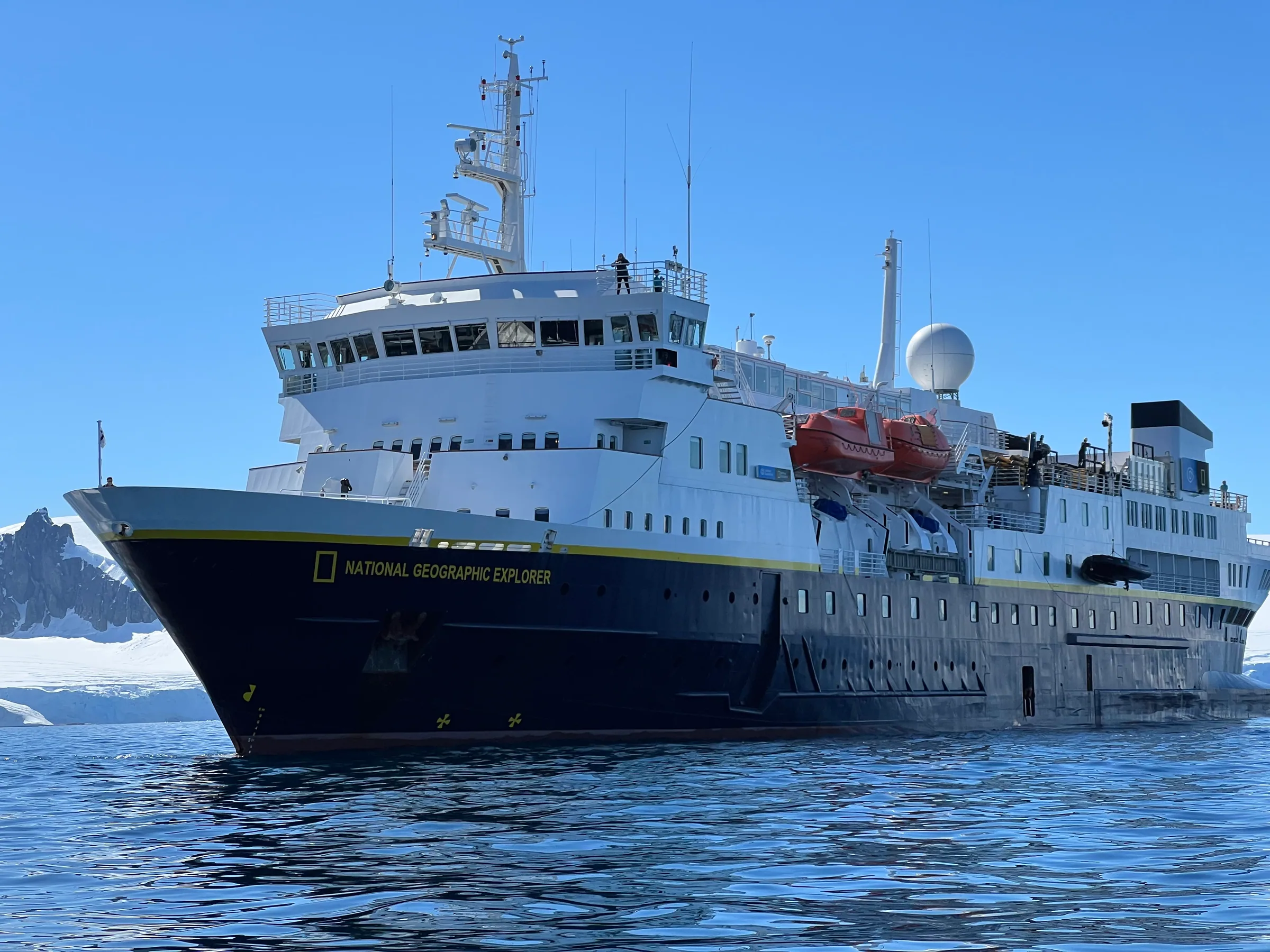
That evening, we boarded the ship that would carry us to Antarctica: the National Geographic Explorer.
The Antarctic journey had officially begun.